Core Drilling Concrete Walls
Wall penetrations are often horizontal. Diameter, wall thickness, access from one or both sides, stand anchoring, slurry control, reinforcement, and working clearance all change the setup.
What this application requires
- Hole diameter and wall thickness (depth)
- Access and clearance for handheld vs stand
- Anchoring method when using a stand (follow manufacturer / project guidance, CoringSpec does not invent anchoring recipes)
- Water/slurry control on vertical faces
- Reinforcement check when walls are reinforced
Find a matching core drill
Typical hole sizes / job conditions
Typical diameter band in planning discussions: 1" to 8"always confirm the actual opening required.
- Horizontal drilling changes slurry and dust behavior vs floor work
- One-sided access may limit bit length and core removal options
- Overhead wet drilling may be restricted by machine manuals (water into motor)
Drill type requirements
Match max diameter and depth capability. Handheld for reachable smaller holes, stand for larger diameter, repeat precision, or when the manufacturer requires it.
Bit requirements
Working depth must cover wall thickness (plus extensions only when documented). Thread must match spindle or a verified adapter path.
Find a compatible core bit
Wet vs dry considerations
Wet is common for concrete walls when the bit requires water. Dry only with documented dry bits and dust control.
Wet vs Dry Core Drilling Guide
Handheld vs stand
Stand preferred when diameter, precision, or fatigue risk rises. Never invent unsafe anchoring steps.
Reinforcement / material considerations
Treat unknown rebar as a risk, filter bits by reinforcement level when walls may contain steel.
Wall penetrations change orientation before they change brand
A wall opening is usually a horizontal or near-horizontal core, sometimes with access from only one side. That orientation changes slurry flow, dust behavior, core control, and the way a stand can be fixed. A machine that is documented for floor work is not automatically documented for wall work. Treat floor, wall, overhead, and angled drilling as separate setup questions rather than as one portable-drill decision.
One-sided access also limits bit length and core removal options. If the wall thickness plus any required stick-out exceeds working length, an undocumented extension assumption is not a pass. Confirm wall thickness against bit working length and stand travel before choosing diameter. The Hole Size Selector can translate pipe or sleeve outside diameter into a catalogue bit size, but it does not replace the depth check.
Handheld versus stand on walls
Handheld wall work is eligible only where the exact model documents handheld capability and the requested diameter fits the published handheld limit. Portability does not remove reaction torque, water control, or manufacturer restrictions. Overhead or near-overhead wet use may be restricted by the machine manual because water can enter the motor. CoringSpec does not invent a safe overhead wet procedure.
Stand-mounted wall work requires a documented motor to carriage relationship and a fixation method that matches the substrate and orientation. Vacuum bases are not inferred from a stand photograph. Anchor bases require an approved location and installation method. Review the Stand and Fixation Map as a reference map, not as a complete system guarantee. Unresolved fixation blocks a complete recommendation.
Slurry, dust, and occupied interiors
Horizontal wet coring sends slurry sideways and downward. Containment, collection, and electrical protection have to be planned for the wall face, not copied from a floor-ring setup. Dry wall work requires documented dry capability plus dust control that the manufacturer actually specifies for that equipment. A generic shop vacuum is not a coring extraction system in this catalogue.
Occupied interiors add cleanup, finish protection, and silica controls that a wet or dry drilling checkbox cannot resolve. Follow current machine and bit instructions and the site competent-person rules. This application page organizes equipment questions, it is not a substitute for those procedures. See wet versus dry for method consequences that stay attached to documented equipment.
Diameter, reinforcement, and through wall planning
Typical planning conversations for walls often sit in a moderate diameter band, but the actual opening is still the pipe, sleeve, conduit, or firestop requirement plus clearance. Do not pick a bit from a “standard wall hole” habit. If the wall may contain rebar, treat reinforcement as its own filter and do not borrow a plain-concrete bit claim. Unknown steel is a risk, not a reason to guess HEAVY.
Through-wall cores need a plan for the exit face, falling core, and any occupied space beyond the wall. Blind holes need a working-length check that is not confused with overall barrel length. Combine this page with reinforced concrete when steel is expected, and with the plumbing, HVAC, or electrical application pages when the opening exists to pass a service.
Common wall-selection errors
The most frequent errors are ignoring wall thickness versus working depth, using wet overhead against manual restrictions, choosing diameter before measuring the service outside diameter, and treating stand capability as proof that a wall-capable stand and fixation kit are included. Another error is assuming every 1-1/4 inch thread is interchangeable without checking the exact spindle and bit records.
Use the candidate VERIFIED machines below only as documentary matches for handheld or stand capable records, then confirm orientation support in the exact manual. Use the Core Drill Finder with your diameter and method. For commercial browsing after the technical constraints are known, see handheld and bit roundups , those pages are not substitutes for the wall-orientation checks on this page.
Worked wall decision without inventing a kit
Suppose the job is a 4-inch sleeve through an 8-inch concrete wall, access from one side, water permitted, and rebar unknown. The documentary order is: confirm the location is allowed to be drilled, measure wall thickness against working length, convert sleeve OD plus clearance into a catalogue diameter, treat unknown steel as a reason to require a stated reinforcement level rather than NONE, require a wet capable machine and wet capable bit if water will be used, require handheld or stand evidence that covers 4 inches in the mode you can actually set up on that wall.
If the only VERIFIED handheld machine that fits 4 inches has no documented wall-orientation note, do not infer wall approval from a floor photo. If a stand capable machine fits but the offer is motor-only, the missing carriage and fixation stay unresolved. If the bit family has a 4-inch wet variant with MEDIUM reinforcement and a matching thread, that variant can be tested in the Bit Finder against the chosen drill. This page’s candidate list is the start of that check, not the end of it.
Compatible Diamond Bit Families for This Trade
Verified diamond bit families selected for diameter availability, segment bond matrix, and application compatibility.
EDiamondTools WBP-A4 Wet Core Bits
VEVOR Wet Core Bit Family
Common mistakes / limitations
- Ignoring wall thickness vs bit working depth
- Wet overhead use against manual restrictions
- Choosing diameter before knowing pipe/sleeve OD + clearance
Safety / claim standard
- Follow manufacturer stand/anchor instructions and project structural requirements.
- Identify embedded utilities before drilling.
Recommended tools
Next steps & equipment selection
Related applications
- Applications hub
- Core Drilling Reinforced Concrete
- Core Drilling Concrete Slabs
- Core Drilling for Plumbing
- Core Drilling for HVAC
- Core Drilling for Electrical Conduit
Related guides & operating procedures
- How to Anchor a Core Drill Stand
- Vacuum Base vs Mechanical Anchor Base
- Slurry Containment & Vacuum Ring Management
- Best Core Drill Stands & Rigs
- Handheld vs Stand Mounted Drilling
Sources
Recommendations are generated from CoringSpec catalog fields (material, reinforcement level, capacity, wet or dry drilling, handheld or stand mounted use). Manufacturer documentation remains the authority for each machine and bit.
Products for this page

Core drill
Husqvarna DM 406 H
25.6" max · hydraulic
Heavy-duty hydraulic stand coring approaching 24, 25.6" in reinforced concrete.

Core drill
Hilti DD 150-U
6.375" max · corded
Premium versatile handheld or stand mounted use benchmark up to 6-3/8".
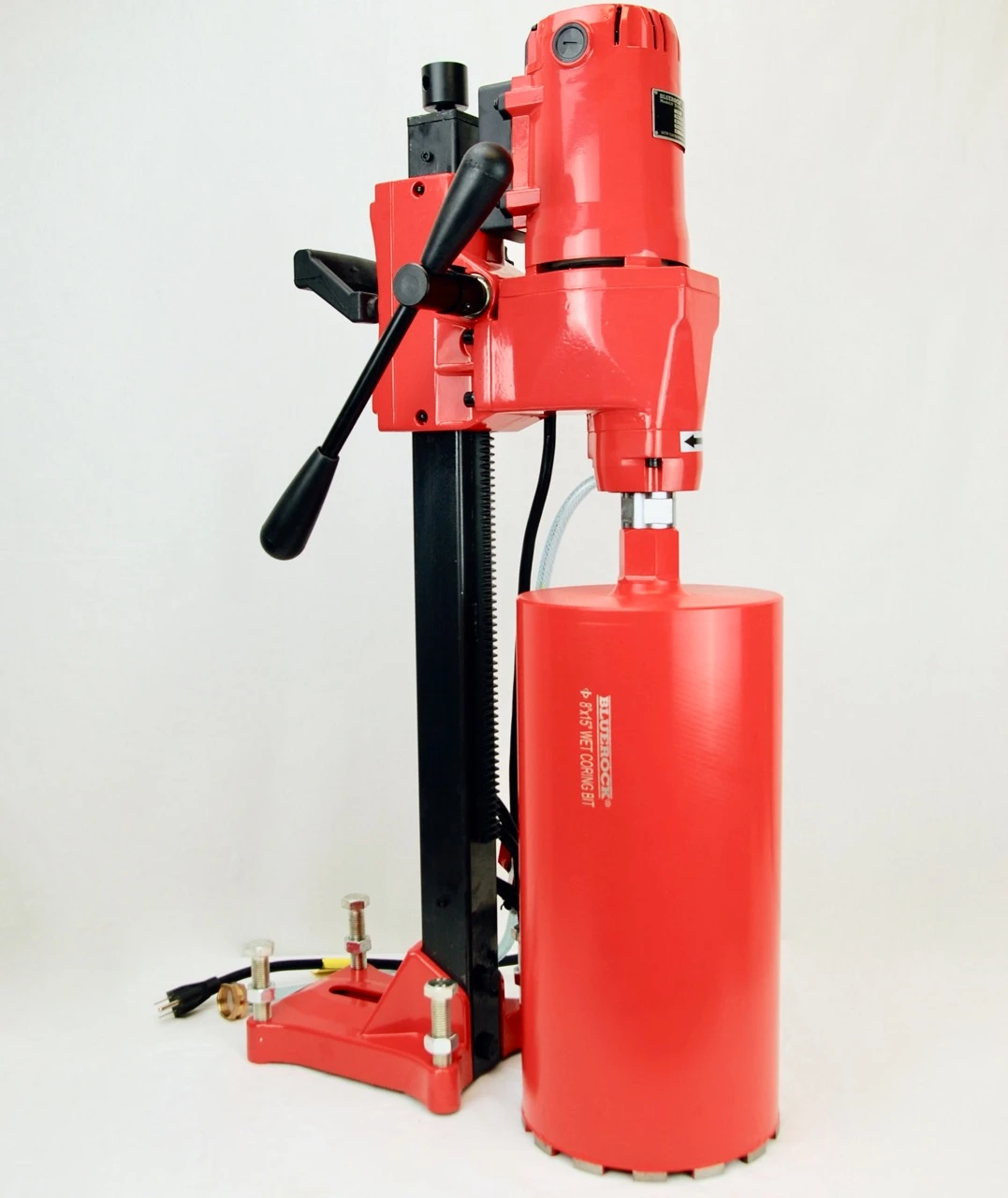
Core drill
BLUEROCK 8Z1
8" max · corded
Mid-size stand-mounted coring up to 8" in reinforced concrete, block, and masonry.

Paid links. Specs on this site come from manufacturer documentation, not from the retailer.