Core Drilling Concrete Slabs
Floor penetrations are typically vertical downward coring. Slab thickness, rebar, slurry management, larger diameters, stand travel, and core retrieval dominate the decision.
What this application requires
- Slab thickness vs bit working depth / stand travel
- Diameter capacity for the opening
- Rebar / reinforcement assessment
- Slurry containment on floors
- Core retrieval plan
Find a matching core drill
Typical hole sizes / job conditions
Typical diameter band in planning discussions: 2" to 10"always confirm the actual opening required.
- Stand-mounted rigs are common for larger diameters
- Wet slurry on floors needs containment
- Post-tensioned slabs require qualified location/verification, no DIY PT cutting guide here
Drill type requirements
Stand-capable machines with documented capacity. Confirm travel vs required depth.
Bit requirements
Depth and reinforcement level must match the slab. Prefer documented reinforced bits when steel is present.
Find a compatible core bit
Wet vs dry considerations
Wet is typical for concrete slabs when the system requires water, manage slurry.
Wet vs Dry Core Drilling Guide
Handheld vs stand
Stand preferred for larger / deeper floor openings.
Reinforcement / material considerations
Slabs often contain rebar or other embeds, use reinforcement filters.
Floor penetrations are vertical systems, not just large bits
Slab coring is typically a downward vertical opening through a floor thickness. The controlling questions are slab depth versus bit working length and stand travel, the finished diameter, whether reinforcement or tendons are present, how slurry will be contained on the floor, and how the core will be retrieved. A large diameter bit without a documented stand path is not a complete floor system.
Stand-mounted rigs are common for larger floor openings because alignment, feed control, and reaction management matter more as diameter grows. Handheld floor work remains eligible only where the exact model documents handheld use and the diameter fits that handheld limit. Do not apply a stand maximum to a handheld floor plan. The stand commercial roundup is a browsing surface after those gates, not a proof that every listed kit includes anchors or a vacuum base.
Slurry, travel, and core retrieval
Wet slab work produces slurry on a walking surface. Containment rings, collection, and disposal have to match the bit diameter and the documented water path. A machine water port does not prove that a tank, ring, or collector is included in the offer. The water and slurry records expose only sourced accessory relationships, they are not automatically scheduled as indexable product pages in the publishing queue.
Stand travel is carriage movement, not a synonym for hole depth. If travel is shorter than the slab thickness, an undocumented extension or a second-side approach is not invented here. Core retrieval on a through-hole can drop into a space below, blind holes need a different removal plan. The Depth Guide keeps working length, overall length, travel, and extensions distinct.
Reinforcement and post-tension risk on floors
Many slabs contain rebar. Some contain post-tension tendons. Rebar is a bit and method eligibility question after the location is allowed. Tendons are a structural-approval question that stops automatic machine and bit selection. CoringSpec does not publish DIY cutting instructions for post tensioned slabs. If PT risk is indicated, the correct next step is qualified location and engineering review, not a larger motor.
When ordinary reinforcement is expected and the location is approved, select bits with documented rebar cutting capabilities and avoid unrated standard bits. of HEAVY use. Prefer machines with documented reinforced-concrete relevance where that field exists. See reinforced concrete and reinforced bit selection for the documentary filters, then return to this page for floor-specific slurry and travel issues.
Diameter planning for floor openings
Planning discussions often mention a wide diameter band for slabs, from modest service openings to larger sleeves. The catalogue still requires an actual required opening, a bit diameter that exists, and a machine capacity in the stand or handheld mode that will be used. Nominal pipe size is not the hole. Firestop, sleeve, and drawing requirements remain authoritative over a calculator suggestion.
Use the Hole Size Selector only as a sizing aid. Then confirm the selected drill in the Core Drill Finder and the bit in the Core Bit Finder. If two candidates both pass, compare configuration completeness , motor-only versus complete rig, included stand versus separate stand, documented water path versus unknown , without inventing a performance winner.
What the candidate lists are allowed to show
Machines listed here are VERIFIED records that match the stand capable filter used by this application. SPEC-MATCHED floor-capable motors may still appear inside finders where a sourced field is needed, but they are not treated as indexed model endorsements on this page. Bit families shown are those whose sampled variants document LIGHT, MEDIUM, or HEAVY reinforcement rather than NONE-only concrete marketing.
Stands, adapters, water, and dust records remain separate catalogue objects. This application page may link to those maps, but those record types are not placed on the automatic Ready to publish schedule. Finish the decision in the System Builder so fixation, connection, gear, and controls are checked against the same frozen evidence used by the finders.
Worked slab decision without a PT shortcut
Suppose the opening is a 6-inch floor sleeve through a 10-inch slab, wet coring allowed, and the drawings do not clear post-tension tendons. Stop at engineering review. Compatibility cannot invent a safe path through an unknown tendon. If the location is later cleared as ordinary reinforced concrete, the documentary order becomes stand-mode capacity at 6 inches, bit working length versus 10 inches plus stick-out, documented structural rebar capability on the diamond bit, wet agreement on machine and bit, slurry containment on the walking surface, and a core-retrieval plan so the plug does not drop into the space below.
A VERIFIED stand capable motor that lists a 6-inch or larger stand maximum can enter the candidate set. A SPEC-MATCHED motor with a sourced diameter still does not become an indexed endorsement here. A wet family with a 6-inch variant still has to match thread and working length. Compare remaining machines on whether the offer is a complete rig or motor-only, not on which listing looks more like a floor rig in a photograph. Then run the System Builder so travel, fixation, and water accessories are named instead of assumed.
Compatible Diamond Bit Families for This Trade
Verified diamond bit families selected for diameter availability, segment bond matrix, and application compatibility.
BLUEROCK Wet Core Bit Series
Milwaukee Diamond Ultra Wet
Common mistakes / limitations
- Equating bit length with stand travel
- Ignoring slurry and cleanup
- DIY assumptions on post tensioned slabs
Safety / claim standard
- Locate/verify embedded systems before drilling, follow qualified project/site procedures.
- Do not treat CoringSpec as structural engineering advice.
Recommended tools
Next steps & equipment selection
Related applications
- Applications hub
- Core Drilling Reinforced Concrete
- Core Drilling Concrete Walls
- Core Drilling for Plumbing
- Core Drilling for HVAC
- Core Drilling for Electrical Conduit
Related guides & operating procedures
- How to Set Up a Concrete Core Drill
- How to Use a Concrete Core Drill
- How to Prevent Concrete Spalling & Blowout
- Slurry Containment & Vacuum Collection
- Best Concrete Core Drills
Sources
Recommendations are generated from CoringSpec catalog fields (material, reinforcement level, capacity, wet or dry drilling, handheld or stand mounted use). Manufacturer documentation remains the authority for each machine and bit.
Products for this page

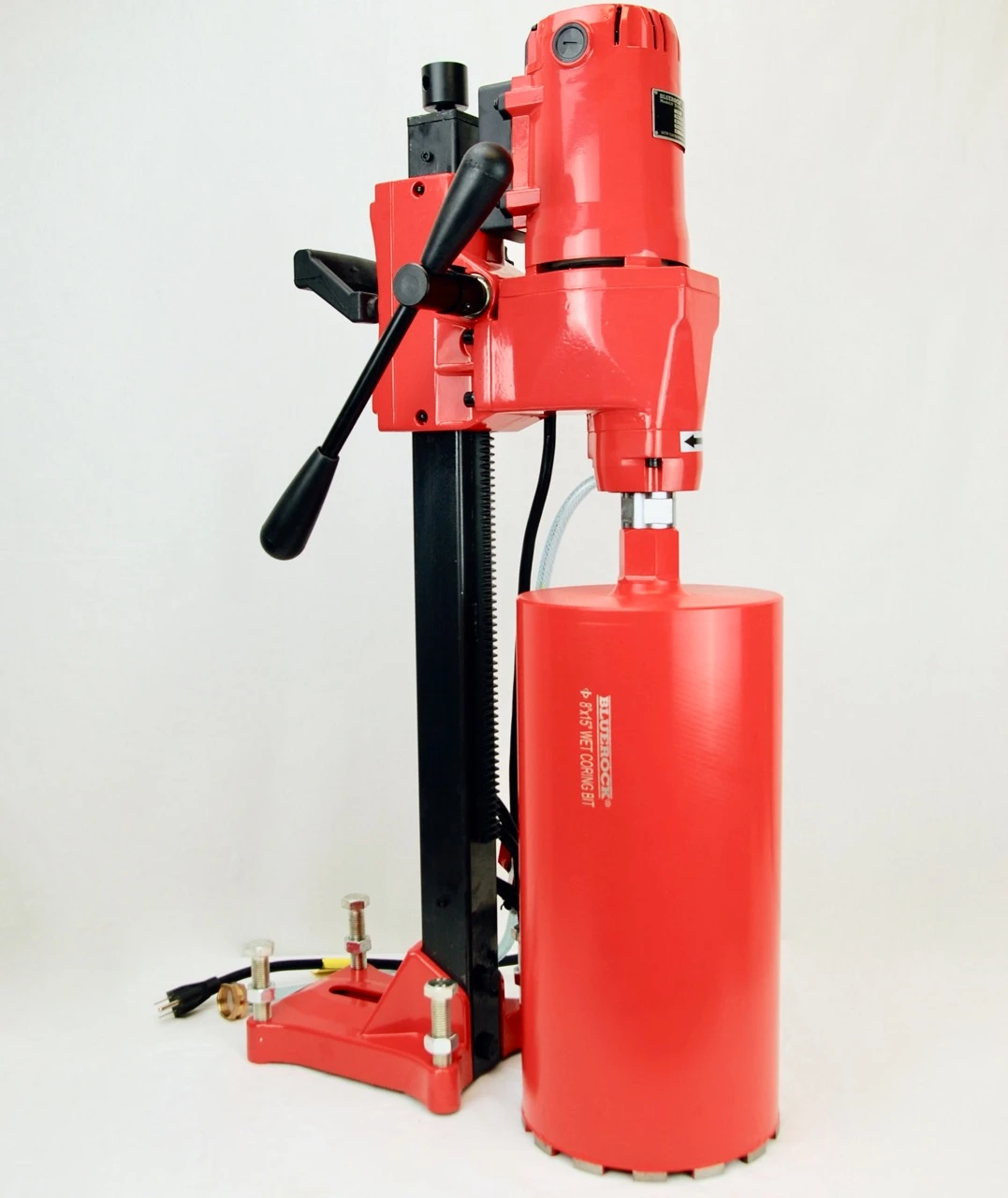
Core drill
BLUEROCK 8Z1
8" max · corded
Mid-size stand-mounted coring up to 8" in reinforced concrete, block, and masonry.

Core drill
CS Unitec END 130/3.2 PO
6" max · corded
Wet coring in confined spaces, handheld to 3-1/4", rig to 6"

Core drill
Husqvarna DMS 400
14" max · corded
Medium-heavy wet stand coring to 14" as a motor+stand US system.
Paid links. Specs on this site come from manufacturer documentation, not from the retailer.