Core Drilling Reinforced Concrete
Reinforced concrete differs from plain concrete because the bit and machine must handle embedded steel as well as the cementitious matrix. Manufacturer documentation, not marketing photos, decides whether a drill or bit is appropriate.
What this application requires
- Documented reinforced-concrete capability on the machine and/or bit
- Bit reinforcement level of LIGHT, MEDIUM, or HEAVY where the job needs it, never assume “concrete” means rebar-ready
- Correct diameter capacity for the hole
- Wet or dry method supported by both drill and bit
- Stand mounting preferred for larger diameters, deeper holes, and precision
Find a matching core drill
Typical hole sizes / job conditions
Typical diameter band in planning discussions: 1" to 10"always confirm the actual opening required.
- Rebar encounter can slow cut rate and raise vibration / bind risk
- Wet cooling often preferred when the bit system requires water
- Standard unrated bits should not be used as heavy-duty rebar tools
Drill type requirements
Select drills with documented reinforced concrete and rebar capability. Motor power and stand mounting become increasingly critical as diameter and penetration depth grow.
Bit requirements
Select bits by verified rebar cutting rating (Plain Concrete, Light Rebar, Medium Rebar, or Heavy Rebar). Generic diamond bits without rebar ratings will glaze or strip segments when contacting steel.
Find a compatible core bit
Wet vs dry considerations
Follow bit + drill documentation. Wet systems aid cooling and dust/slurry control when required, dry only when the specific combination is documented.
Wet vs Dry Core Drilling Guide
Handheld vs stand
Smaller penetrations may be handheld where capacity allows. Larger / deeper / precision reinforced work usually favors a stand.
Reinforcement / material considerations
When a bit hits rebar, cutting rate drops and stress on the spindle rises. Do not force a NONE/Not specified bit through heavy reinforcement. Stop and reassess method, bit family, and RPM.
Why reinforced concrete is a different eligibility test
A reinforced-concrete opening is not the same decision as a plain-concrete opening. The cementitious matrix still has to be cut, but embedded steel changes load, vibration, cooling demand, and the chance of bind. CoringSpec therefore treats reinforcement as an eligibility field rather than a marketing adjective. A machine or bit that is documented only for concrete is not silently upgraded to rebar work. If manufacturer documentation does not explicitly specify steel cutting capability, verify segment metallurgy before attempting structural rebar work.
The useful first question is whether the location is even allowed to be drilled. Post-tensioned or prestressed members, unknown embeds, and undocumented utilities are structural and safety problems, not catalogue matching problems. When that risk is indicated, CoringSpec stops automatic selection and calls for engineering review. Compatibility between a drill and a bit does not approve the penetration. Only after the location is cleared should diameter, depth, method, and mounting be used to screen equipment.
Machine evidence that actually matters here
For this application, prefer machines whose records document reinforced-concrete use, a maximum diameter that covers the finished opening, and an operating method that the selected bit can share. Handheld capability can be relevant for smaller penetrations when the handheld limit is published. Stand-mounted capability becomes more important as diameter, depth, alignment, and fatigue risk rise. Brand reputation is not a substitute for those fields.
Capacity must be read in the mode that will actually be used. A stand maximum cannot be borrowed for a handheld plan. A general maximum cannot be split into two invented mode limits. If the required mode is blank, the machine does not pass a hard diameter requirement in that mode. The Core Drill Finder applies those gates, this page explains why the gates exist for rebar work.
Bit reinforcement levels are not interchangeable
Bit records specify verified reinforcement ratings from unreinforced masonry to heavy rebar cutting matrices. Ratings reflect manufacturer testing rather than generic marketing claims. not quality scores. NONE is not a claim that the bit will never meet steel. Unverified bit suitability is not permission to drill heavy structural steel. Standard masonry bits are not adequate for congested rebar cages. Choose the variant whose published level matches the expected steel, then confirm diameter, working length, thread, and wet or dry status on that same variant.
Family names do not copy one reinforcement statement onto every diameter. If only some SKUs in a family document rebar, the undocumented sizes stay undocumented. Use the Core Bit Finder and the reinforced-concrete bit roundup to inspect sourced fields. Do not assume that a concrete marketing line means the bit is appropriate for substantial reinforcement.
Wet, dry, RPM, and bind risk
Wet paths are common on reinforced concrete when the bit requires water for cooling and slurry control. Dry paths are eligible only when both the machine and the exact bit document dry use and the site can control dust. Missing water hardware is not dry approval. A wet only bit on a dry only plan is an exclusion, not a field improvisation.
Speed evidence stays diameter-specific. A machine gear table and a bit maximum answer different questions. Forcing a higher gear through rebar to “make it cut” is not a CoringSpec recommendation. Bind, glazing, and overheating are diagnostic conditions that require stopping and rechecking material, method, cooling, and RPM against the current manuals. See wet versus dry and the RPM Matrix.
Depth, stand travel, and core removal
Requested hole depth, bit working length, overall barrel length, and stand travel are different numbers. A long-looking barrel can have a shorter usable drilling depth. A stand can have less travel than the slab or wall thickness. Extensions are accepted only through documented connection paths and do not erase stability or cooling requirements. Plan how the core will be removed, especially when steel is likely to hold a plug.
The Depth Guide keeps those fields separate. If working length is unknown and depth is a hard requirement, the result should name that gap instead of treating overall length as a pass. For floor penetrations that may contain rebar or tendons, combine this page with slab guidance after the location is approved.
How to use the candidate lists below
The machine list on this page is limited to VERIFIED catalogue records that document reinforced-concrete relevance under the application filter. SPEC-MATCHED machines can still contribute a sourced field inside decision tools, but they are not presented here as endorsed indexed models. The bit-family list is limited to families with a published reinforcement sample in LIGHT, MEDIUM, or HEAVY. Non-core bit categories and custom accessories are documented separately in the catalog.
Neither list is a paid ranking or a prediction of cutting speed. After a candidate survives these documentary filters, confirm the exact model identifier, included equipment, spindle, bit SKU, water or dust path, and current manufacturer instructions. Then use the Complete System Builder so stand, adapter, gear, and controls are checked in the same decision, not added after purchase.
Diamond Matrix & Rebar Metallurgy: Bit manufacturers specify steel cutting capability based on segment weld integrity (laser-welded vs brazed), diamond grit concentration, and cobalt/tungsten bond matrix formulation. Structural reinforced concrete requires matching the bit matrix to both aggregate hardness and embedded steel density.
Compatible Diamond Bit Families for This Trade
Verified diamond bit families selected for diameter availability, segment bond matrix, and application compatibility.
Milwaukee Diamond Ultra Wet
EDiamondTools WBP-A4 Wet Core Bits
Common mistakes / limitations
- Assuming every “concrete” bit is rebar-rated
- Ignoring bit max RPM vs machine gear
- Oversizing the machine without checking bit reinforcement level
- Skipping wet requirements on wet only bits
Safety / claim standard
- Follow manufacturer instructions and competent-person / jobsite procedures.
- Locate embedded utilities and follow project requirements before drilling.
- Post-tensioned members require qualified verification, CoringSpec does not provide DIY cutting instructions for PT slabs.
- Manage silica dust and water near electrical equipment per site controls.
Recommended tools
Next steps & equipment selection
Related applications
- Applications hub
- Core Drilling Concrete Walls
- Core Drilling Concrete Slabs
- Core Drilling for Plumbing
- Core Drilling for HVAC
- Core Drilling for Electrical Conduit
Related guides & operating procedures
- Core Drilling Through Structural Rebar (Operating Guide)
- Diamond Core Bit Wear Patterns & Segment Life
- Best Diamond Core Bits for Rebar
- Best Core Drills for Reinforced Concrete
- Core Drill RPM Calculator
Sources
Recommendations are generated from CoringSpec catalog fields (material, reinforcement level, capacity, wet or dry drilling, handheld or stand mounted use). Manufacturer documentation remains the authority for each machine and bit.
Products for this page
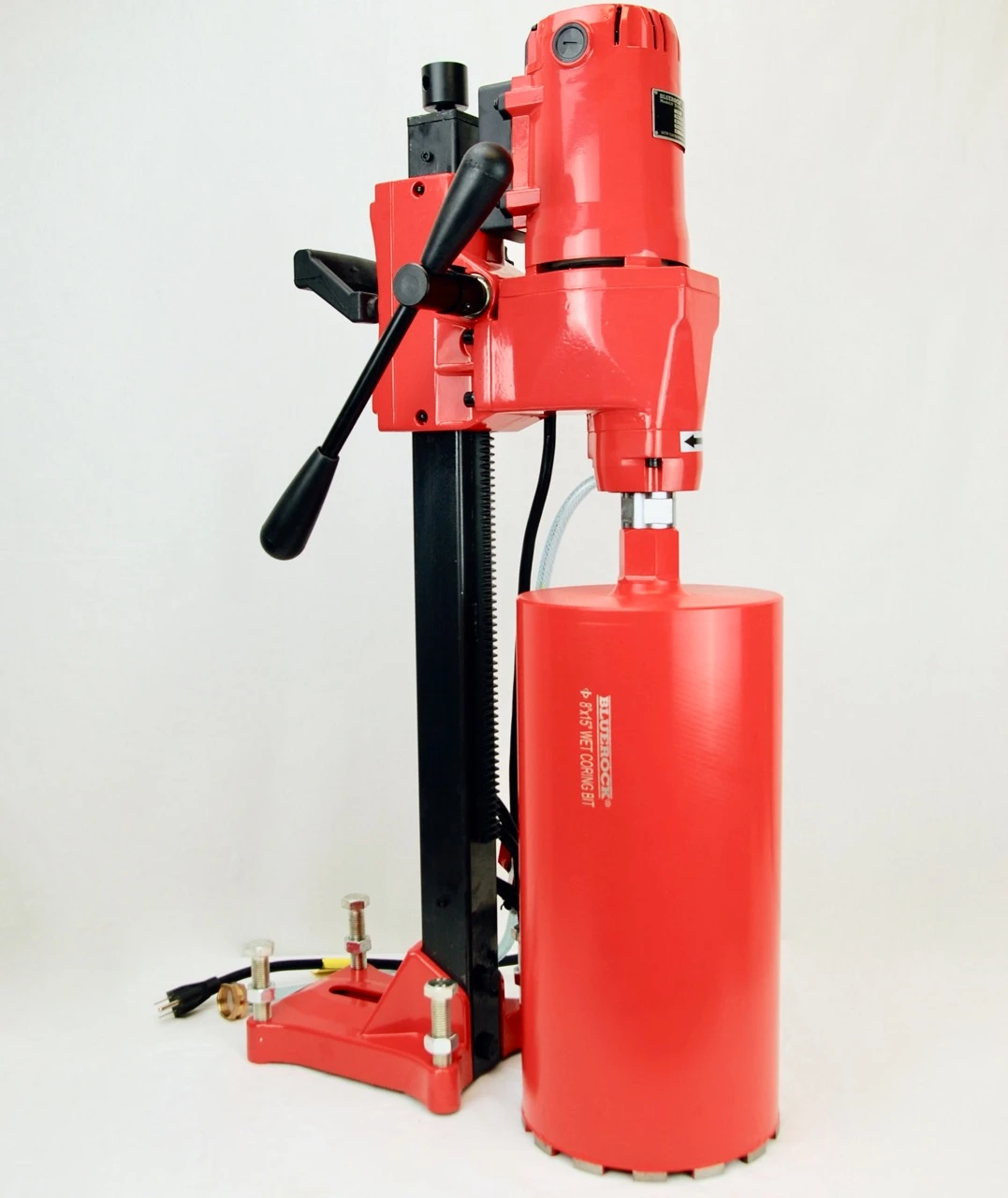
Core drill
BLUEROCK 8Z1
8" max · corded
Mid-size stand-mounted coring up to 8" in reinforced concrete, block, and masonry.

Core drill
Husqvarna DM 540i
4" max · cordless
Lightweight cordless commercial handheld / light stand work.

Core drill
VEVOR Z1Z-9260
11.8" max · corded
Largest VEVOR budget stand tier for holes approaching 12".

Paid links. Specs on this site come from manufacturer documentation, not from the retailer.