CoringSpec Editorial
Quick Answer: To prevent concrete blowout and spalling on the exit face, reduce carriage feed pressure by 50-70% during the final 1 inch of penetration, secure a sacrificial wooden or steel backing plate against the exit surface, or drill a small pilot hole to core from both sides.
The Physics of Concrete Exit Blowout (Spalling)
Concrete possesses high compressive strength (3,000-6,000+ PSI) but very low tensile strength (typically only 10% of compressive strength, ~300-500 PSI). Throughout the depth of the slab, the surrounding concrete mass provides lateral and backing confinement against the diamond segment cutting forces.
However, when the bit reaches the final 1/2″ to 1″ of slab thickness, the thin remaining concrete layer lacks tensile support. Heavy downward feed pressure causes tensile shear failure before the diamond segments can grind through, blowing out a large, cone-shaped spall crater on the bottom or back face.
Engineering Techniques to Eliminate Blowout
- Feathered Feed Pressure (Final 1 Inch): As the bit approaches breakthrough (monitor depth markings on the barrel), ease off carriage pressure significantly. Let the weight of the motor and light segment contact grind through the exit face smoothly.
- Sacrificial Clamped Backing Plate: For architectural ceilings, precast panels, or finished walls, clamp a 3/4″ marine plywood board or steel plate tightly against the exit face using through-bolts or shoring posts. The backing plate maintains compression until the diamonds fully exit.
- Dual-Sided Pilot Coring:
- Drill a small 1/2″ pilot hole completely through the slab or wall at the exact center.
- Core drill halfway from the finished visible face.
- Move the drill rig to the opposite side and core to meet the center kerf, guaranteeing razor-sharp, chip-free edges on both faces.
- Sharp, High-Diamond Segments: A dull or glazed bit exerts massive axial thrust load without cutting efficiently, dramatically increasing blowout risk. Ensure segments are dressed and sharp before finishing deep holes.
Blowout Prevention Methods Comparison
| Method | Application | Exit Quality | Labor / Time Required |
|---|---|---|---|
| Feathered Feed Reduction | Standard floor slabs & non-critical walls | Good (Minor 1/4″ chipping) | Zero extra setup time |
| Clamped Plywood Backer | Finished walls, architectural panels, exposed ceilings | Excellent (Zero chipping, crisp edge) | 5-10 mins to clamp backer plate |
| Dual-Sided Pilot Coring | Thick structural walls & precision mechanical penetrations | Flawless (Crisp 90° edge on both sides) | Requires rig repositioning & two-sided access |
Safety Hazards of Breakthrough Debris
When coring elevated floor slabs, breakthrough releases a solid concrete core weighing 10 to 50+ lbs, along with several gallons of pressurized slurry. Always barricade the lower drop zone, assign a safety spotter, and install a tethered core catch basket beneath the penetration to prevent severe injury to workers below.
Related Guides & Application Hubs
- Concrete slab drilling guide: Core Drilling Concrete Slabs Application
- Wall coring application: Core Drilling Concrete Walls Application
- Operating technique guide: How to Use a Concrete Core Drill
- Find verified core drills: Core Drills Catalog
Sources
Structural drilling standards based on ACI 318 Concrete Finishing Guidelines, CSDA Concrete Penetration Best Practices, and OSHA 1926 Overhead Protection Standards.
Post-Breakthrough Slab Rebar & Core Handling Protocol
Managing the completion of a full-depth penetration requires strict safety procedures:
| Breakthrough Risk | Hazard Description | Standard Control Measure |
|---|---|---|
| Falling Core Impact | Heavy core drops through slab onto lower floor or workers | Install expanding mechanical core catcher or sub-slab support shoring |
| Slurry Torrent | Pressurized water floods lower occupied ceiling/space | Construct sealed containment funnel with wet vacuum extraction |
| Bottom Rebar Hanging | Core breaks loose but hangs on a single uncut bottom rebar strand | Slow spindle to minimum gear; grind rebar strand lightly until fully severed |
Pre-Stressed & Hollow Core Precast Slab Breakthrough Rules
Drilling pre-stressed concrete hollow-core slabs (commonly used in multi-story parking garages and commercial floors) presents unique breakthrough challenges:
- Void Chamber Breakthrough: As the bit breaks through the top 2-inch concrete flange into the hollow internal air void, feed resistance drops to zero instantly. Operators must hold back carriage feed to prevent the heavy motor from free-falling into the void and slamming diamond segments into the bottom flange.
- Prestressing Strand Location: High-strength 7-wire prestressing steel strands are tensioned to 70% of ultimate tensile strength. Never core drill through a hollow core web containing strands without structural engineering authorization.
- Slurry Trapping in Voids: Water and slurry will fill internal slab voids during drilling; always drill small 3/8″ drainage weep holes in the bottom flange to prevent trapped water from freezing and spalling precast panels in winter.
Products for this page

Core drill
Hilti DD 150-U
6.375" max · corded
Premium versatile handheld or stand mounted use benchmark up to 6-3/8".

Core drill
Husqvarna DM 406 H
25.6" max · hydraulic
Heavy-duty hydraulic stand coring approaching 24, 25.6" in reinforced concrete.

Core drill
VEVOR Z1Z-CF02-80
4" max · corded
Budget handheld wet coring for 3.1", 4" plumbing/HVAC holes when a stand rig is not required.
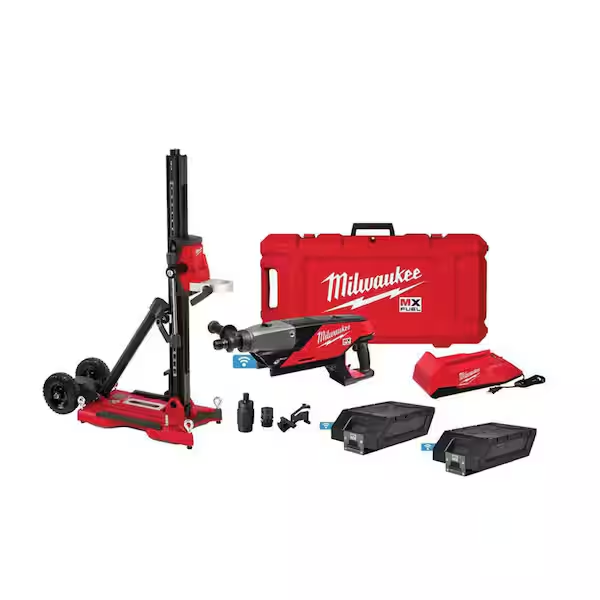
Core drill
Milwaukee MXF301-2CP
6" max · cordless
Premium cordless wet or dry drilling reinforced-concrete coring up to 6" with stand capability.
Paid links. Specs on this site come from manufacturer documentation, not from the retailer.