CoringSpec Editorial
Quick Answer: If a core bit seizes in concrete, immediately release the motor trigger to avoid electrical burnout. Do not attempt to force the motor in reverse. Disconnect power, attach an open-ended wrench or pipe wrench to the bit arbor flats, and gently rock the barrel back and forth while applying steady upward carriage tension and continuous water flow.
Primary Root Causes of a Stuck Core Bit
- Segment Undercutting / Core Barrel Binding: If side clearance is lost, the steel tube rubs against the outer concrete wall and inner core, creating extreme friction that wedges the barrel tight.
- Rebar Sliver / Steel Shaving Jamming: Grinding through rebar can shear off a small curl or sliver of steel that falls into the narrow kerf clearance (typically 0.5-1.0 mm), mechanically wedging between the barrel and concrete.
- Core Cylinder Fracturing & Shifting: In cracked slabs or hollow core precast, the inner concrete core can fracture horizontally and tilt sideways inside the barrel, locking the tube in place.
- Slurry Settlement (Hydraulic Lock): If water flow stops suddenly while deep in a cut, heavy concrete sludge settles around the barrel and flash-hardens, cementing the tube in the kerf.
- Stand Anchor Loosening: If the stand anchor shifts during drilling, the drill axis angles off 90°, pinching the barrel in the misaligned hole.
Step-by-Step Bit Recovery Procedure
| Recovery Step | Action Required | Technical Method | Critical Precaution |
|---|---|---|---|
| 1. Power Isolation | Disconnect power cord | Unplug unit from receptacle or disconnect battery pack | Prevents sudden motor spin if the jam frees unexpectedly |
| 2. Check Rig Alignment | Inspect stand leveling | Check if stand base shifted relative to anchor bolt | If misaligned, loosen carriage slightly to relieve angular stress |
| 3. Manual Wrench Rocking | Apply wrench to arbor flats | Fit a 1-1/4″ or 36 mm wrench onto bit hex collar; rock clockwise & counterclockwise 10-15° | Do not hammer on the thin steel barrel tube (dents tube permanently) |
| 4. Re-establish Water Flushing | Turn water valve full open | Pressurize water supply to wash loose aggregate and slurry out of the kerf | Ensures flushed sludge does not re-cement the segments |
| 5. Carriage Upward Tension | Engage feed wheel | Apply gentle upward tension on carriage while rocking arbor wrench | Never use a forklift or heavy pry bar that could bend spindle shaft |
Advanced Recovery for Severe Jams
- Air / Water Jet Flushing: Insert a thin 1/4″ copper tube attached to high-pressure compressed air or water down the kerf side to blast out trapped aggregate chips or rebar slivers.
- Thermal Differential Technique: Pour ice water down the inside of the core barrel. Steel contracts when chilled, slightly shrinking the barrel diameter away from the hot concrete walls.
- Core Extraction Drill-Out (Last Resort): If the barrel is permanently seized deep in a slab, remove the motor, unthread the spindle adapter, and drill an overlapping perimeter hole with a smaller 1″ bit to relieve compressive pressure on the stuck barrel.
How to Prevent Future Jams
- Verify Segment Overhang: Never drill with bits whose segments have worn flush with the steel barrel tube.
- Maintain Continuous Water Flow: Never turn off water until the spinning bit is completely retracted from the hole.
- Apply Anti-Seize to Spindle Threads: Always grease threads to ensure the motor can be unthreaded from a jammed bit if emergency extraction is required.
Related Guides & Troubleshooting Pages
- Diagnose cutting performance loss: Why Is My Core Bit Not Cutting?
- Check stand anchor methods: How to Anchor a Core Drill Stand
- Inspect bit wear patterns: Diamond Core Bit Wear Patterns
- Find replacement bits: Diamond Core Bits Catalog
Sources
Procedures based on Concrete Sawing & Drilling Association (CSDA) Field Operations Handbook, Milwaukee MX FUEL Core Drill Service Manual, Hilti Diamond Coring Technical Bulletin, and Husqvarna Construction Troubleshooting Manuals.
Chemical & Mechanical Jam Relief Methods
When physical rocking with an arbor wrench fails to dislodge a stuck core bit, specific chemical and pressure-assisted techniques can be deployed safely:
- Citric Acid Slurry Dissolution: If the bit was trapped by flash-hardened concrete slurry, pump a mild 10% citric acid or commercial concrete dissolver solution down the kerf. Allow 20 minutes to soften the calcium matrix before re-applying wrench tension.
- Slurry Suction Vacuum Relief: If vacuum suction is holding the wet core inside the barrel, drill a 1/4″ pressure-relief hole through the top of the concrete core using a small hammer drill to break hydraulic vacuum.
- Reverse Rotation Precautions: Never use the motor under power to run in reverse. Reverse torque under load unthreads the bit from the spindle, leaving the bit loose and jammed deeper in the hole with no connection point.
Products for this page

Diamond core bit
Husqvarna DRI-8
2" shown · dry
Pro dry coring 2" × 10" on documented Husqvarna drill motors.

Diamond core bit
Milwaukee Diamond Ultra Dry
4" shown · dry
Dry diamond coring in concrete, brick, and block, RPM calculator source row.
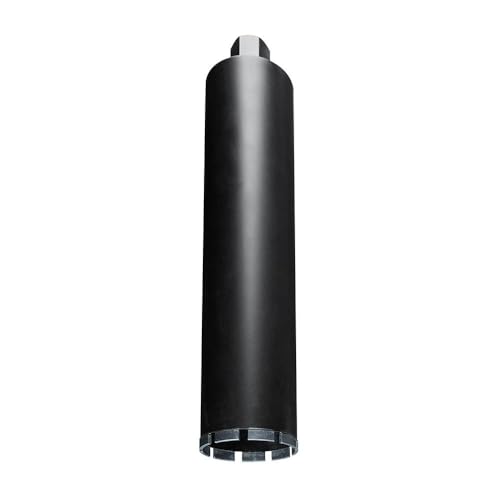
Diamond core bit
Milwaukee Diamond Ultra Wet
4" shown · wet
Wet diamond coring in concrete/rebar-oriented work at manufacturer max RPM 660.
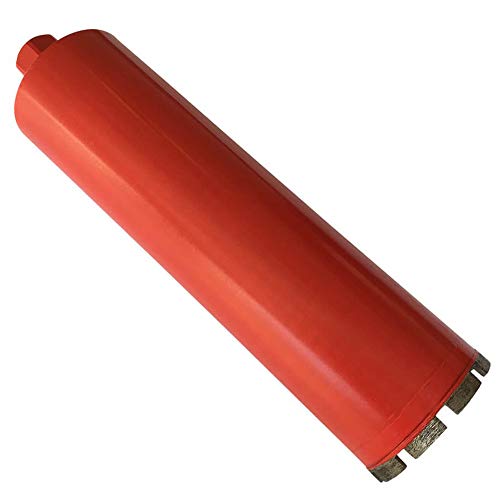
Diamond core bit
EDiamondTools Wet Premium (WBP A4)
4" shown · wet
Amazon-facing wet coring at 4" with 14" depth and 1-1/4"-7 UNC thread.
Paid links. Specs on this site come from manufacturer documentation, not from the retailer.