CoringSpec Editorial
Quick Answer: Core drill vibration is typically caused by a loose stand anchor, excessive spindle or barrel runout (>0.5 mm), loose carriage slide gibs, uneven segment wear, or attempting to start a bit on loose aggregate. Severe vibration rapidly destroys diamond segments, overheats gearbox bearings, and risks anchor failure.
Vibration Diagnostics & Root-Cause Matrix
| Vibration Symptom | Probable Root Cause | Diagnostic Check | Corrective Action |
|---|---|---|---|
| Entire column shakes back and forth | Loose stand anchor bolt or uneven leveling feet | Push top of mast by hand; check base contact | Torque center anchor nut to the anchor manufacturer specified installation torque; lock all 4 leveling feet |
| Barrel visibly wobbles / oscillates | Bent core barrel or spindle adapter runout | Rotate bit by hand with dial indicator or visual pointer | Replace bent barrel; check spindle runout (limit 0.1 mm) |
| Motor chatters loose on column | Worn or loose carriage guide rollers / brass gibs | Wiggle motor carriage side-to-side on column | Tighten carriage guide adjustment screws evenly |
| Rhythmic high-frequency clicking | Segment striking rebar rib or loose aggregate trapped in kerf | Inspect slurry color and feed resistance | Ease feed pressure by 30%; increase water flush flow |
| Violent jumping on cut startup | Attempting to start on rough/uneven aggregate or dry slab | Inspect entry kerf circularity | Feather feed handle lightly until 1/4″ circular groove is cut |
How to Measure and Isolate Runout
Runout refers to the deviation of the spinning shaft or barrel from a true circular axis. Total indicated runout (TIR) should never exceed 0.5 mm (0.020″) at the segment tip.
- Test Bare Spindle Runout: Remove the core bit and adapter. Place a dial test indicator against the bare motor spindle shaft and rotate by hand. Maximum allowable spindle runout is 0.05 mm (0.002″). If higher, spindle bearings or shaft are damaged.
- Test Spindle Adapter: Thread on the spindle adapter (if using 1-1/4″ to 5/8″ or Hilti adapter). Measure runout on the adapter OD. Cheap adapters often introduce 0.3-0.5 mm of wobble.
- Test Barrel Runout: Thread on the core bit. Measure runout at the steel tube midpoint and at the segment crown. If the barrel is out-of-round from prior drops or jamming, it must be replaced.
Safety & Mechanical Hazards of Persistent Vibration
- Silver Braze Fatigue: Continuous resonant vibration creates fatigue stress on segment braze joints, leading to segment detachment inside the hole.
- Gearbox Gear Stripping: Intermittent shock loading damages internal reduction gears and mechanical safety slip clutches.
- Operator Hand-Arm Vibration Syndrome (HAVS): When using handheld core drills, excessive vibration exceeds OSHA / ANSI safe daily exposure limits, causing nerve and vascular damage in hands and wrists.
Related Diagnostic Guides & Tools
- Troubleshoot non-cutting bits: Why Is My Core Bit Not Cutting?
- Bit wear pattern diagnostics: Diamond Core Bit Wear Patterns
- Stand setup procedures: How to Anchor a Core Drill Stand
- Explore verified core drills: Core Drills Catalog
Sources
Vibration limits derived from ISO 5349 Mechanical Vibration Measurement Standards, CSDA Equipment Maintenance Guidelines, Hilti DD 150-U Service Manual, and Husqvarna Construction Rig Tolerances.
Spindle Bearing & Gearbox Wear Inspection
When vibration originates from the drill motor itself rather than external mounting, check the internal mechanical drive train:
| Drive Train Component | Wear Indicator | Maximum Allowable Tolerance | Service Action |
|---|---|---|---|
| Front Spindle Bearings | Radial play when grasping spindle by hand | 0.05 mm (0.002 in) radial play | Replace front dual tapered roller bearings |
| Spindle Shaft Threads | Galled or flattened 1-1/4″-7 threads | Zero visible thread stripping | Chase threads with die or replace spindle output shaft |
| Column Rack & Pinion | Carriage slips or jerks along gear track | Zero missing or chipped teeth | Replace brass pinion gear or machined steel rack |
Harmonic Resonance & Segment Spacing Engineering
In large-diameter core drilling (6″ to 14″+), vibration can occur as an acoustic phenomenon known as harmonic resonance. When diamond segments are spaced at perfectly identical intervals around the barrel perimeter, each segment impacts aggregate at identical time intervals, setting up a rhythmic standing wave in the column mast.
Premium professional diamond core bits utilize uneven segment pitch spacing (asymmetrical segment intervals) or rooftop segment crowns to break up harmonic frequency buildup. If experiencing resonant chatter with older symmetric bits, changing gearbox speed by one gear step or slightly altering water flow volume alters the fluid damping dynamics, breaking the harmonic vibration loop.
Handheld Core Drill Anti-Vibration Controls
For handheld core drilling motors (such as the Hilti DD 110-W or Husqvarna DM 230), excessive vibration transmitted to the operator is controlled through mechanical slip clutches and decoupled rubber vibration-dampened rear handles. Operators should maintain a firm, balanced two-handed grip with knees slightly bent, allowing the core bit kerf to guide the machine rather than attempting to fight high-frequency micro-chatter with tense muscles.
Products for this page

Core drill
VEVOR Z1Z-9260
11.8" max · corded
Largest VEVOR budget stand tier for holes approaching 12".

Core drill
Husqvarna DM 540i
4" max · cordless
Lightweight cordless commercial handheld / light stand work.
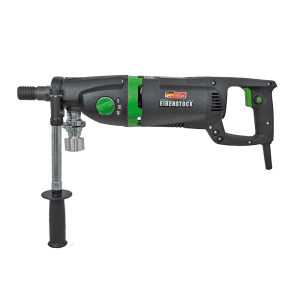
Core drill
CS Unitec ETN 162/3 P
6.375" max · corded
Professional wet or dry drilling handheld or stand diamond coring

Core drill
Hilti DD 110-W
6.375" max · corded
Handheld Hilti BI+ wet concrete / dry masonry coring in the DD 110-W diameter bands.
Paid links. Specs on this site come from manufacturer documentation, not from the retailer.