CoringSpec Editorial
Quick Answer: Choose a rotary hammer (SDS-Plus or SDS-Max) for fast anchor holes under 1-1/2″ diameter where minor micro-fracturing and rough edges are acceptable. Choose a diamond core drill for clean, perfectly round penetrations from 1-1/2″ to 14″+ diameter, cutting through embedded rebar, preserving structural integrity, or working in occupied structures without percussive vibration.
Operating Mechanism Comparison
A rotary hammer uses an electro-pneumatic piston mechanism to deliver high-impact mechanical blows (joules of impact energy) to a carbide-tipped drill bit while rotating slowly. This pulverizes concrete by crushing impact, creating micro-fracturing in the surrounding concrete matrix and spalling on the breakthrough face.
A diamond core drill uses pure rotary motion without any percussive hammering. Diamond segments grind an annular ring (kerf), removing only the perimeter and leaving a solid cylindrical concrete core. This eliminates structural shock waves, prevents micro-cracking, cuts cleanly through heavy rebar, and leaves perfectly smooth hole walls suitable for mechanical seals and firestop collars.
Engineering Comparison: Core Drill vs. Rotary Hammer
| Factor | Rotary Hammer (SDS-Plus / SDS-Max) | Diamond Core Drill |
|---|---|---|
| Typical Hole Diameter Range | 3/16″ to 1-1/2″ (Solid bit); up to 4″ (Carbide core cutter) | 1/2″ to 14″+ (Standard); up to 24″+ (Commercial rig) |
| Cutting Mechanism | Rotational percussion / high-energy impact pulverizing | Rotational abrasive grinding with diamond segments |
| Structural Rebar Capability | Limited; carbide tip often binds, shatters, or deflects on rebar | Excellent; cuts smoothly through structural steel rebar |
| Hole Quality & Edge Precision | Rough, jagged perimeter with micro-cracks and blowout spall | Glass-smooth, precision round hole with zero micro-fracturing |
| Vibration & Noise Impact | High vibration transmitted through slab/wall; high impact noise | Low rotational vibration; quiet cutting (essential in occupied hospitals/offices) |
| Speed in Small Holes (<1″) | Extremely fast (15-30 seconds for small anchor holes) | Slower setup time; requires water containment or vacuum rig |
| Dust / Slurry Generation | High dry silica dust (requires HEPA shroud/vacuum) | Wet slurry flushed with water or dry HEPA vacuum capture |
Decision Framework: Which Tool Should You Use?
- Use a Rotary Hammer When:
- Installing mechanical concrete wedge anchors, drop-ins, or Tapcons (1/4″ to 3/4″).
- Drilling rebar dowel holes for structural slab extensions and seismic retrofits.
- Speed and portability on scaffolding or ladders outweigh hole precision.
- Use a Core Drill When:
- Drilling utility penetrations for plumbing waste pipes (2″, 3″, 4″), electrical conduit, HVAC line sets, or dryer vents.
- Penetrating reinforced concrete walls or post-tension slabs where steel rebar is present.
- Holes must accept rubber Link-Seal mechanical boots or firestop sleeve assemblies requiring exact dimensional tolerances.
- Working in occupied commercial facilities (hospitals, data centers, corporate offices) where hammering vibration could disrupt sensitive equipment or tenants.
Jobsite Safety & Structural Preservation Rules
When penetrating structural shear walls, bridge decks, or post-tension slabs, percussion hammer drilling can cause micro-cracking that weakens the concrete bond surrounding structural tension cables. Structural engineering specifications on commercial projects frequently mandate rotary-only diamond core drilling to preserve building integrity.
Related Tools & Guides
- Select core drill machinery: How to Choose a Concrete Core Drill
- Size MEP penetrations: Hole Size Calculator
- Explore commercial rigs: Core Drills Catalog
- Rebar cutting procedures: Core Drilling Through Rebar Guide
Sources
Comparative engineering data derived from ACI Concrete Anchor Guidelines, OSHA Construction Silica Table 1 Standards, Hilti Technical Handbooks (TE vs DD series), and CSDA Industry Technical Bulletins.
Breakout Spalling & Structural Vibration Comparison
In structural engineering and mechanical contracting, the decision between percussion hammer drilling and diamond core drilling frequently comes down to structural preservation and edge quality:
| Engineering Requirement | Rotary Hammer Outcome | Diamond Core Drill Outcome |
|---|---|---|
| Mechanical Pipe Seals (Link-Seal) | Unacceptable; irregular hole circumference prevents watertight sealing | Ideal; true round tolerance allows 100% hydrostatic sealing |
| Firestop Caulking & Collars | Requires extra mortar patching around jagged blowout spalls | Clean circular kerf fits firestop sleeves with minimal sealant waste |
| Structural Post-Tension Slabs | Percussion shock risks debonding adjacent tensioned tendons | Zero impact shock; safe for proximity drilling near scanned tendons |
| Occupied Facility Coring | High acoustic decibels (105+ dB) and transmitted structural vibration | Quiet continuous grinding (75-85 dB); zero structural thumping |
Products for this page

Core drill
CS Unitec END 130/3.2 PO
6" max · corded
Wet coring in confined spaces, handheld to 3-1/4", rig to 6"
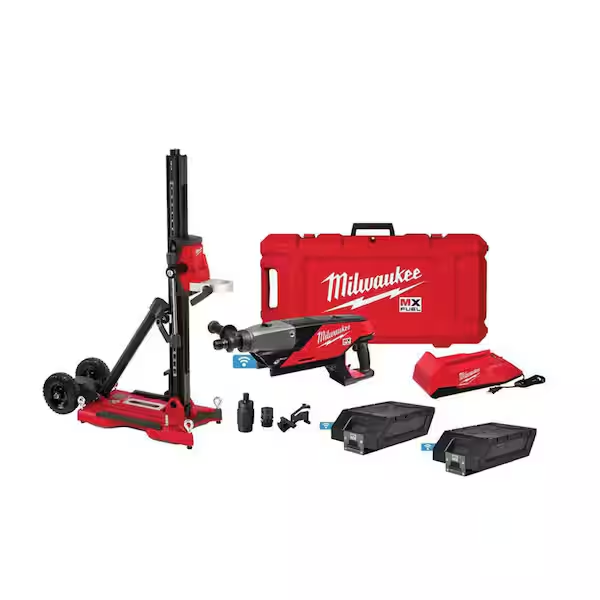
Core drill
Milwaukee MXF301-2CP
6" max · cordless
Premium cordless wet or dry drilling reinforced-concrete coring up to 6" with stand capability.

Core drill
VEVOR 6.3" 2000W Handheld
6.3" max · corded
Larger handheld budget coring when 4" machines are too small and a stand is not required.

Core drill
BLUEROCK 4Z1
4" max · corded
Budget handheld (optional stand) for 1", 4" holes in concrete, block, brick, or asphalt.
Paid links. Specs on this site come from manufacturer documentation, not from the retailer.