CoringSpec Editorial
Quick Answer: A professional-grade diamond core bit typically lasts between 30 and 150+ linear feet of drilling in standard concrete, or approximately 30 to 150 holes in an 8-inch slab. Lifespan varies dramatically depending on aggregate hardness (flint vs limestone), rebar density, continuous water cooling, and operator feed pressure.
Key Variables Determining Core Bit Lifespan
- Aggregate Hardness (Mohs Scale): Limestone and marble (Mohs 3-4) allow bits to last 100-200+ feet. River gravel, granite, and basalt (Mohs 6-7) reduce life to 40-80 feet. Flint, chert, and quartzite (Mohs 7+) can reduce life to 20-40 feet.
- Rebar & Structural Steel: Every pass through heavy #5 or #8 structural steel rebar consumes segment height equivalent to 3-5 inches of plain concrete.
- Cooling Method (Wet vs. Dry): Wet core drilling with continuous water flow provides 2x to 4x longer bit lifespan compared to dry drilling, as water eliminates thermal segment breakdown and flushes abrasive slurry out of the kerf.
- Diamond Quality & Bond Specification: High-grade synthetic diamond grit with cobalt-nickel matrix bonds lasts significantly longer than budget consumer bits using low-grade copper-iron sintered matrices.
Footage & Hole Count Estimation Table
| Concrete Type & Job Condition | Aggregate Type | Reinforcement Level | Estimated Linear Feet | Holes in 8″ Slab |
|---|---|---|---|---|
| Standard Residential Slab (3000 PSI) | Limestone / Dolomite | None / Light wire mesh | 100-180 ft | 150-270 holes |
| Commercial Floor Slab (4000 PSI) | River Gravel / Crushed Stone | #4 Rebar @ 12″ O.C. | 60-110 ft | 90-165 holes |
| Heavy Structural Concrete (5000+ PSI) | Granite / Trap Rock | Dense #6 Rebar Grid | 35-70 ft | 50-105 holes |
| Prestressed / High-Density Concrete | Quartzite / Chert / Flint | Heavy Rebar / Steel fibers | 20-45 ft | 30-65 holes |
| Abrasive Block / Green Concrete | Cinder / Sand / Fly-ash | None | 40-80 ft (high abrasive wear) | 60-120 holes |
Practical Field Methods to Extend Core Bit Life
- Never Run Below Optimal RPM: Running large bits at excessive speed polishes diamonds; running small bits too slowly creates excessive drag that rips diamonds from the matrix prematurely.
- Maintain Consistent Water Volume: Keep slurry at a milky consistency. Dry or muddy slurry traps heat and abrades the steel barrel tube.
- Avoid Starting on Loose Debris: Sweep or vacuum aggregate chips off the slab before starting. Grinding loose gravel on top of the slab causes severe impact chatter that micro-fractures diamonds.
- Lock Down Stand Rigs Firmly: Stand vibration or carriage play creates eccentric bit rotation, causing one side of the segment crown to wear 3x faster than the rest.
- Re-Dress Glazed Bits Promptly: When cutting slows down, do not apply brute force. Drill into an abrasive cinder block or refractory brick for 30 seconds to re-expose sharp diamonds.
Cost-Per-Hole Economic Analysis
When calculating core drilling costs, high-performance professional diamond bits (e.g., $180 for a 4″ bit delivering 100 feet of life = $1.80/ft) consistently yield a lower cost-per-hole than budget economy bits ($80 for a 4″ bit delivering only 20 feet of life = $4.00/ft), while eliminating downtime from frequent bit swaps.
Related Tools & Selection Reference
- Check bit specifications & SKU inventory: Diamond Core Bits Catalog
- Size holes for MEP penetrations: Hole Size Calculator
- Compare drilling applications: Applications Directory
- Bit selection framework: How to Choose a Diamond Core Bit
Sources
Lifespan averages compiled from CSDA Drill Operator Training Manuals, Hilti Diamond Bit Specification Data Sheets, Husqvarna Construction Products Diamond Tool Life Guide, and field testing benchmarks.
Aggregate Mohs Hardness & Regional Geology Impact
Concrete compressive strength (PSI) alone is not the primary driver of diamond bit wear. Regional aggregate mineralogy is the dominant factor controlling bit lifespan:
| Aggregate Mineral | Mohs Hardness | Abrasion Index | Expected Bit Footage Impact |
|---|---|---|---|
| Limestone / Dolomite | 3.0-3.5 | Low Abrasion | Maximum bit life (120-200+ linear ft) |
| Basalt / Traprock | 5.5-6.0 | Moderate Abrasion | Standard bit life (70-110 linear ft) |
| Granite / Quartz | 6.0-7.0 | High Abrasion | Reduced bit life (40-75 linear ft) |
| Flint / Chert / Quartzite | 7.0-7.5 | Extreme Hardness | Minimum bit life (20-40 linear ft) |
In regions with hard glacial chert or flint aggregate (such as the upper Midwest and Pacific Northwest), bits must be specified with extra-soft bonds to prevent rapid glazing, while limestone-heavy regions (such as Texas and the Midwest) yield significantly longer tool life.
Products for this page
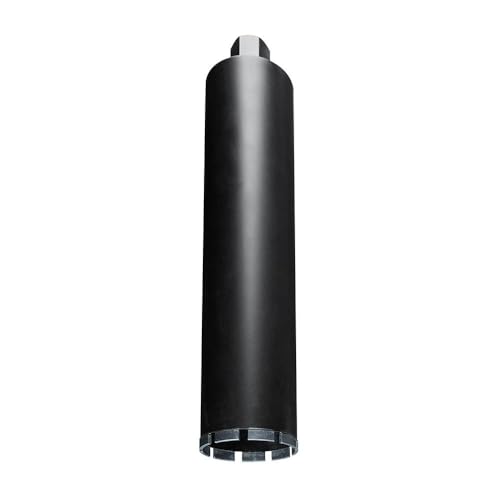
Diamond core bit
Milwaukee Diamond Ultra Wet
4" shown · wet
Wet diamond coring in concrete/rebar-oriented work at manufacturer max RPM 660.
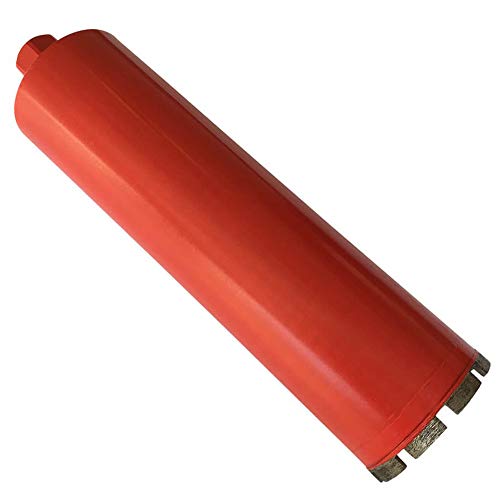
Diamond core bit
EDiamondTools Wet Premium (WBP A4)
4" shown · wet
Amazon-facing wet coring at 4" with 14" depth and 1-1/4"-7 UNC thread.

Diamond core bit
BLUEROCK Wet
4" shown · wet
Wet concrete/masonry coring at 4" on 1-1/4"-7 UNC machines within capacity.
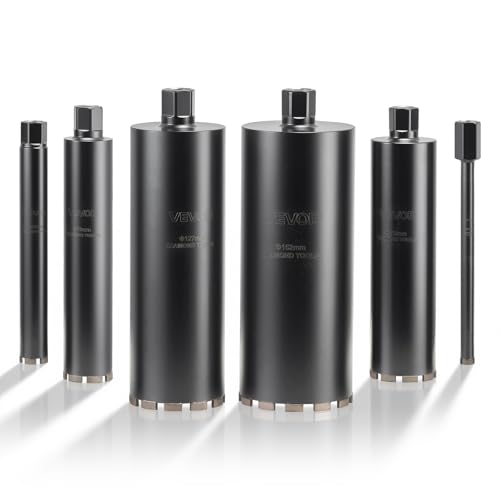
Diamond core bit
VEVOR Wet Core Bit Set
6" shown · wet
Value multi-size wet kit: 1, 2, 3, 4, 5, and 6" bits, universal 1-1/4"-7 UNC, 14" depth.
Paid links. Specs on this site come from manufacturer documentation, not from the retailer.